
Rethinking What It Means to Prepare a Teacher
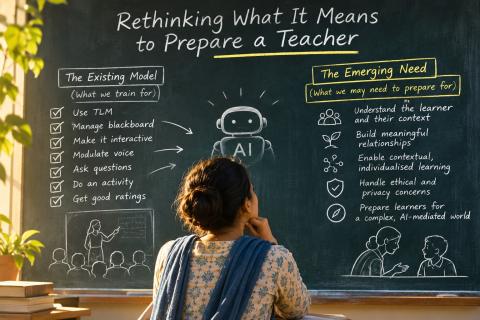
I have been observing a lot of classes of my student-teachers. Many of them are doing really well. Many of them have figured out what it means to be a good teacher in the eyes of a supervisor. They carry some TLM and use it during observation. They use blackboards appropriately. They make classrooms interactive. They make an effort to make their voices loud and also use voice modulation. They ask a couple of questions for assessment. They introduce some activities, and so on. On a given checklist, they satisfy all the conditions to appear as a good teacher. On the rating parameters, they also get good ratings.
I have been thinking that all that is being demonstrated and measured may soon lose its significance. AI is able to do all these demonstrations which may count. Then, which new skills and disposition do they need to remain relevant in the classroom?
The industrialised form of teaching and learning made learning decontextualised. Most of us feel that learning is disconnected from the lived realities of both teachers and learners. I remember a beautiful poem Dr. Sanjay Kumar shared at SCERT during a workshop, and a sentence in it was: "Children do the homework, but fail to work at home." I found it one of the finest ways to express what modern education has reduced learning to: an ability to perform a task which has some monetary value. Educationists have been raising their concerns and asking for reform, but in the existing model of education, there isn't space for contextualised learning. AI may finally lead the existing model to redundancy.
Then what alternate model do we have? Nothing new—the gap between homework and work at home should disappear. How might this happen? Teachers in a new model have to teach the learners, not the lesson. And learners are human beings. They are situated in certain socio-cultural ecosystems. Teachers need to engage deeply in understanding the context of the learners. The lesson delivery part of teaching would be taken care of by AI. Teachers need to engage with the learners. The existing system doesn't have much space or scope for it. In the existing model, a teacher teaches more than 250 students across grades in a year; deeper engagement is not possible in this model.
Let's call it context-specific, individualised and situated learning. This is ideal. However, I also want to highlight certain challenges associated with this. This alternate model brings teachers closer to the world of children. They receive a lot of personal information. Are they trained to handle this? How can it be ensured that access to exclusive personal information about children is not used against them? I think this is a question for all of us who are engaged in teacher education.
Summing it up, what the student teachers are demonstrating is not a lack of skill. They are demonstrating what the existing system expects from them. However, there is a strong apprehension that the rising AI revolution may soon make these skills redundant. Are they ready for the alternate system? I think asking this question is the beginning of a new preparation.
- Log in to post comments