
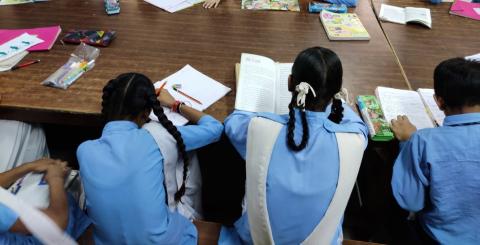
Before We Call Them Careless Parents
I have often seen that whenever a parent comes to school to ask for leave for their child, they hear comments like, “They always need leave. They have no interest in their children’s learning.” Teachers and principals often feel forced and conditioned to view the situation strictly through the lens of administration. They constantly worry: “If attendance is so mandatory, how will students sit for exams? How will they learn?” Deep down, they begin to feel that these parents simply do not want to educate their children.
But there are other realities—especially in the context of the schools where you will be teaching and the kind of children who enroll there.
Look at a couple of data points.
According to the State of Working India 2018 report published by Azim Premji University, in 2015, 92% of female workers and 82% of male workers earned less than ₹10,000 a month. The latest PLFS data show that, in 2025, average monthly earnings were ₹24,217 for men and ₹18,353 for women in regular wage/salaried employment, while female self-employed workers earned an average of just ₹6,374 a month, compared with ₹17,914 for men. The World Inequality Lab's 2024 paper, Income and Wealth Inequality in India, 1922–2023: The Rise of the Billionaire Raj, estimates that in 2022–23 the top 1% held 40.1% of India's wealth and received 22.6% of national income There is a massive section of the population that is severely distressed. The children you will interact with come from extreme deprivation. There is no income security at home, and both mothers and fathers work grueling long hours.
I do not know your personal experiences, but I regularly talk to many children and parents. I have come across parents who work 24-hour shifts. You might wonder how that is even possible. They work as security guards. If it is a 12-hour shift, they do two shifts consecutively. During night shifts, if there is any downtime, they might catch two to four hours of sleep, but they are technically on duty for 24 hours straight. I meet many such parents. I also come across many children—and some of your own stories might align with this—whose parents leave for work before the children even wake up for school.
Frequently, young girls studying in the 6th, 7th, or 8th grade pack lunch for their working parents. When these children return home from school, they prepare the evening meal for their families.
These are not anecdotal stories. This is the stark reality. You need to understand this reality when you go out into the field and talk to these children. Given these economic conditions—in which roughly 80% of our children grow up—do you think parents have any real choice? If they quit their jobs to stay home with their children, how will they feed them? And if they continue working, they face extreme work conditions. There is no such thing as an 8-hour workday for the poor; shifts are rarely under 12 hours. If they miss even a single day of work, their salary is docked. If they miss three or four days, they lose their job. They must show up even when they are sick or during festivals. The poor do not have the luxury of festivals, sick leave, or downtime.
Given this reality, imagine assuming that these parents do not care about their children's education, that they are irresponsible, or that they neglect their children.
Is that fair?
These parents simply lack choices. What else can they do?
Sometimes, parents take their children back to their home villages for a month. Again, this stems from socio-cultural and economic factors. Suppose there is a wedding in the family or a after death ceremony where extended rituals last 15 days to a month. This is not simply a matter of personal preference. In our social structure, if someone fails to attend these events, they can face social boycott. Relatives may cut ties, saying, “They did not stand by us in our time of need, so we will not support them.”
They have no choice. They must go.
Furthermore, our informal economy has become deeply unorganized and fragile. Today, we use terms like “gig work” or “unstable employment,” which offer zero job security. A job exists today, but it might be gone tomorrow. Many parents face sudden job losses and have no idea when they will find work again. In such situations, they send their wives and children back to their native villages.
What choice does a child have in this scenario?
None at all.
This is the context you are stepping into. And this is why you have a critical role to play as empathetic and sensitive teachers.
You must understand both sides of the coin.
Teachers are not operating in comfortable isolation, but parents are often in far worse circumstances. Therefore, the most essential factor is your communication and awareness. If you understand their reality, you will never dismiss them as “careless parents who do not want to educate their children.” Such words will never cross your mind.
Generally, you get about two hours for a PTM, during which you are responsible for engaging with the parents of your specific class. Yet a PTM is not merely about sitting across a table and telling a parent whether their child has passed or failed. It is about communication. It is about understanding. It is about creating a space where a parent feels that the teacher is listening. And this is particularly important because the class divide between teachers and parents can be enormous.
Class is a powerful social dynamic.
Regular teachers often hold a socio-economic standing far higher than that of the families attending government schools. Because of this class barrier, it can be extremely difficult for these parents to confront a teacher. So, if a parent actually voices a concern, it may have taken tremendous courage for them to do so. That courage deserves respect. We often interpret confrontation simply as aggression. But sometimes, behind that confrontation is fear, helplessness, frustration, or the feeling that nobody listens to them.
Of course, you will meet challenging parents too.
Some parents may operate in denial, blaming the teacher whenever a child struggles academically. Some may come shouting: “Why isn't my child learning?” “How did my child get injured?” “Why are the marks so low?”
You have to be prepared for these situations. But preparation does not mean learning how to win an argument. It means learning how not to turn a difficult interaction into a confrontation. If someone is shouting or using abusive language, you do not need to prove that you are right. Step back. Seek support from the regular teacher, senior coordinator, or principal. There is no shame in asking for help. In public-facing roles, you encounter a wide spectrum of human behaviour. Navigating these interactions is itself a professional skill. And perhaps this is one of the most important things you will learn during your school experience programme.
Teaching is not only about teaching the child. It is also about understanding the world that the child comes from. A child does not walk into your classroom alone. They bring their parents, their economic circumstances, their neighbourhood, their family responsibilities, their anxieties, their hunger, their aspirations, and sometimes their helplessness with them. If we forget that, we may become very efficient teachers—and perhaps insensitive human beings.
So, when you go for your school experience programme, I want you to observe carefully. Observe how the school responds to absence, to poverty, to parental anger, to children who fall behind, to children who suddenly disappear from school. And, most importantly, before you make a judgement, ask yourself one simple question: What choices does this person actually have? That question can change the way you see your students. It can change the way you conduct a PTM. And perhaps, over time, it can change the kind of teacher you become.
- Log in to post comments