
Education and the Good Life
Bertrand Russell — Passages That Stayed With Me
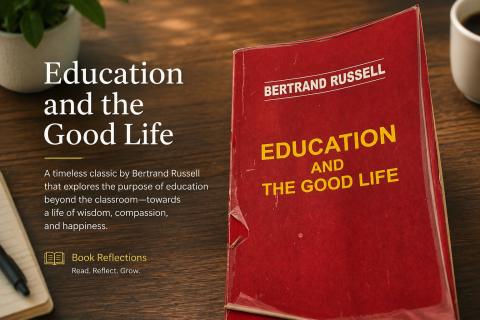
I recently finished reading Bertrand Russell's Education and the Good Life. Its clarity on fear, love, and freedom in raising and teaching children stayed with me long after I closed the book. Below are a few passages I underlined while reading — quoted directly, with the page numbers noted in brackets.
“Apart from such considerations, children and young people feel instinctively the difference between those who genuinely wish them well and those who regard them merely as raw material for some scheme. Neither character nor intelligence will develop as well or as freely where the teacher is deficient in love; and love of this kind consists essentially in feeling the child as an end. We all have this feeling about ourselves: we desire good things for ourselves without first demanding a proof that some great purpose will be furthered by our obtaining them.” (p. 58)
“Courage is essential to intellectual probity, as well as to physical heroism. The real world is more unknown than we like to think; from the first day of life we practise precarious inductions, and confound our mental habits with laws of external nature. All sorts of intellectual systems—Christianity, Socialism, Patriotism, etc.—are ready, like orphan asylums, to give safety in return for servitude.” (p. 78)
“The old idea was that children could not possibly wish to learn, and could only be compelled to learn by terror. It has been found that this was entirely due to lack of skill in pedagogy.” (p. 86)
“Untruthfulness, as a practice, is almost always a product of fear. The child brought up without fear will be truthful, not in virtue of a moral effort, but because it will never occur to him to be otherwise. The child who has been treated wisely and kindly has a frank look in the eyes, and a fearless demeanour even with strangers; whereas the child that has been subject to nagging or severity is in perpetual terror of incurring reproof, and terrified of having transgressed some rule whenever he has behaved in a natural manner. It does not at first occur to a young child that it is possible to lie. The possibility of lying is a discovery, due to observation of grown-ups quickened by terror.” (p. 158)
“The child has a natural tendency to believe what you say, except when it runs counter to a strong desire.” (p. 164)
“Well-to-do people imagine themselves superior to their cooks, and behave to them in a different way from that in which they behave in society. But they feel inferior to a Duke, and treat him in a way which shows a lack of self-respect. In both cases they are wrong: the cook and the Duke should both be felt and treated as equals. In youth, age makes a hierarchy which is not artificial; but for that very reason the social habits which will be desirable in later life are best learnt by associating with contemporaries. Games of all kinds are better among equals, and so is school competition. Among schoolfellows, a boy has that degree of importance which is accorded to him by their judgment; he may be admired or despised, but the issue depends upon his own character and prowess. Affectionate parents create a too indulgent milieu; parents without affection create one where spontaneity is repressed. It is only contemporaries who can give scope for spontaneity in free competition.” (p. 183)
“The traditional view was that, within marriage, it is always justifiable to have children, even if they come so fast that the mother's health is ruined, even if the children are diseased or insane, even if there is no prospect of their having enough to eat. This view is now only maintained by heartless dogmatists, who think that everything disgraceful to humanity redounds to the glory of God.” (p. 219)
“A mathematician who had to stop to realize the meaning of each step in his transformations would never get through his work; the essential merit of his instrument is that it can be used without this labour. In higher education, therefore, the dynamic method seems inadequate. I cannot help thinking that its popularity in America is partly due to the notion that all excellence consists in doing, rather than in thinking and feeling. This notion is implicit in the definition of culture which I quoted just now, and is natural in a mechanical age, since a machine can only do, and is not expected to think or feel. But the assimilation of men to machines, whatever may be thought of it metaphysically, is hardly likely to give us a just standard of values.” (p. 246)
“Open-mindedness is a quality which will always exist where desire for knowledge is genuine.” (p. 246)
- Log in to post comments