
Democracy Doesn't Allow People's Movements; It's Rooted in Them
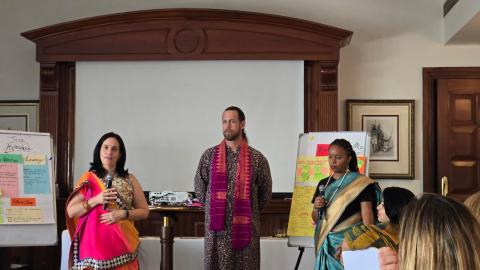
I was interacting with a group of Fulbright Teachers participating in the Global Classroom program. They were here to experience and understand the educational landscape of India. During our conversations, one theme surfaced repeatedly—their sense of awe at the scale of students' protests in India. One of the teachers referred to the now-iconic picture of the Mumbai girl standing fearlessly in front of a police vehicle during the recent protests. Her question was : How does an Indian girl have this courage?
I responded that electricity, the internet, and transportation are so integral to modern life that we cannot imagine living without them. In the same way, freedom of speech, equality, justice, and fraternity are not abstract ideals for Indians; they are lived experiences. They are woven into the fabric of our democratic life. We often forget that democracy is not merely a system of government. It is a culture built through generations of struggle and participation.
Indian democracy is rooted in at least fifty years of mass movements during the freedom struggle. Even after Independence, people’s movements continued in different forms, shaping public policy, expanding rights, and holding governments accountable. Democracy does not merely permit people’s movements; democracy is rooted in them. Public protest is not an exception to democracy—it is one of its defining features.
This understanding is also embedded in our education system. We teach public movements through History and Political Science textbooks. Students learn about the freedom struggle, social reform movements, constitutional values, and democratic participation as part of their school education. But learning does not remain confined to textbooks. For Indian students, witnessing a public protest is often a lived reality. They grow up seeing people gather peacefully to express disagreement, demand justice, or seek accountability. This familiarity makes democratic participation appear natural rather than extraordinary.
Above all, India is the home of one of the greatest leaders of mass movements—Mahatma Gandhi. Gandhi did not merely advocate peaceful protest; he experimented with it and established it as perhaps the most effective tool to negotiate with those in power. What makes this achievement remarkable is that he developed and refined this method against what was then considered one of the most powerful and brutal colonial empires in history. His success demonstrated that moral force, collective participation, and non-violence could challenge even the mightiest political authority.
The effectiveness of Gandhi's methods did not remain confined to India. They travelled across the world and inspired numerous civil rights and democratic movements. From the American Civil Rights Movement to struggles against authoritarian regimes in different parts of the world, peaceful mass mobilisation repeatedly proved that organised citizens possess immense democratic power.
Historian Bipin Chandra offers a fascinating explanation of why people’s movements become so powerful. He identifies two special characteristics of peaceful mass movements. First, when a large number of people unite against the government, it creates an atmosphere in which the government begins to appear weak. Second, if the government uses force against peaceful protesters, it loses moral legitimacy because violence against non-violent citizens is widely seen as uncivilised and unjust. This further damages the government's credibility. If the government chooses not to use force, the movement often gathers greater momentum, more people join, and the government may increasingly appear incapable of governing effectively.
Bipin Chandra describes this as a situation similar to "one side trench and the other side well" for the government. Whatever path it chooses carries significant costs. For those participating in a peaceful protest, however, it is almost always a win-win situation. Their moral position strengthens regardless of the government's response.
He further argues that wherever democracy was planted without a preceding people's movement, it rarely survived for long. Democracy cannot simply be imported through constitutions or elections. It draws its strength from citizens who have learned, through collective struggle, that governments derive legitimacy from the people. People's movements are therefore not disruptions to democracy; they are an essential part of the ecosystem that enables democracy to survive, renew itself, and thrive.
Perhaps that is why the courage of the young girl standing before the police vehicle did not surprise many Indians. She was not acting in isolation. She was standing on the shoulders of generations who taught us that democracy lives not only in Parliament or the Constitution, but also in the conscience and collective action of ordinary citizens.
- Log in to post comments