
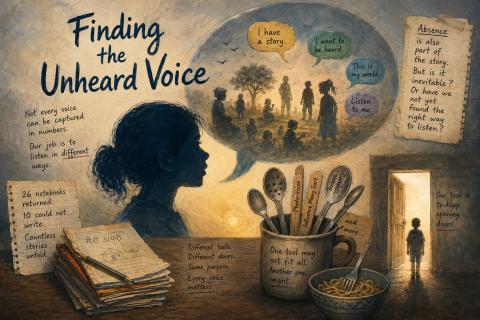
Finding the Unheard Voice
Responding to my previous blog post, “When Numbers Cast a Shadow,” Binsy Eapen wrote:
"I am curious, while qualitative research prioritizes meaning over numbers, how do you think researchers should think about the voices that remain absent from the data? Does the absence of certain participants also become part of the story we are trying to understand?"
I think this question lies at the very centre of the qualitative research process.
For a long time, human voices were overshadowed by converting them into numbers. Qualitative research emerged, in part, as an attempt to restore that voice. Yet even within qualitative research, an important question remains: how do we represent those voices that are absent? How do we account for those who could not participate, or whose experiences remain outside our data?
Researchers often encounter participants who request that their voices not be anonymised. They want their names attached to their stories. They want recognition, not concealment. This reminds us that voice is not merely data; it is also identity, agency, and ownership.
The concern raised in my previous post, however, is slightly different. When I wrote that what is written is more important than who has written it or how many have written it, I was not dismissing the value of unheard voices. Rather, I was arguing against the dominance of numbers in determining the worth of an idea. The absence of certain voices remains important, but I tend to treat it as a methodological limitation that researchers must acknowledge and address.
I encountered this challenge in my own research. There were at least ten students in my classroom who could not participate in the writing process because they did not know how to "write." Even today, I find it difficult to use the word write without quotation marks. During my research, I discovered that schools often teach copying rather than writing.
Copying is the ability to reproduce symbols by looking at an existing model—much like drawing a mango or a table while looking at a picture. Through repeated drills, students become highly skilled at this form of imitation. Writing, however, is something fundamentally different. By writing, I mean the ability to express one's thoughts and feelings through socially accepted symbols. This requires agency, meaning-making, and expression. I have written about this in a separate piece.
Very few students were able to do this.
I could collect only twenty-six notebooks. Even among those who participated, many were unable to submit their notebooks when I came to collect them. The reason was not carelessness. Most of these children came from households that could hardly be described as households in the conventional sense. They were often temporary arrangements for surviving under a shelter. Perhaps I still do not have the right words to describe these living conditions. One can find a more vivid account in Farah's classic Ek School Manager Ki Diary.
My assumption that every child would have a safe place at home to keep books and notebooks—and later retrieve them when needed—reflected my limited understanding of the socio-economic deprivation experienced by many children attending government schools.
For a qualitative researcher, ensuring that people find their voice is of prime importance. Over the years, particularly while working with groups of researchers, I realised that relying on a single method often excludes some participants. It is therefore essential to engage people through multiple tools and approaches.
Not everyone can write. Not everyone can participate through an interview. Not everyone can express themselves in the same way.
Today, I have a much wider repertoire of tools available to me: photovoice, card sorting, influence mapping, Delphi techniques, and many others. I often think of these tools as different kinds of spoons. What one shape and size fails to collect from a utensil, another may successfully gather. To make the analogy more concrete, if noodles are difficult to pick up with a regular spoon, one might use a fork instead.
My point is simply this: different qualitative research tools enable different people to participate. Each tool opens a different door into human experience. The challenge for the researcher is not merely to collect voices, but to keep expanding the possibilities through which people can speak.
Perhaps the absence of certain voices does become part of the story. But our responsibility as researchers is to continuously ask whether that absence is inevitable, or whether we simply have not yet found the right tool to listen.
- Log in to post comments