
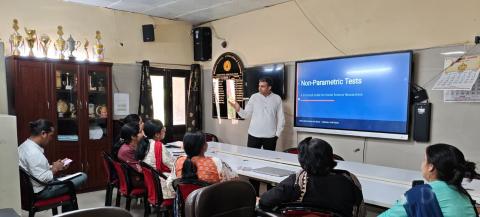
In Search of a Learning Culture
Last week, in a peer learning session, I witnessed something unusual.
The senior-most faculty member, during his presentation, remarked, "Isme main bhi confused hun, ham expert se puchhenge." A little later, he added, "Jitni knowledge hai, us hisab se bata raha hun."
The statement may appear ordinary, but I found it extraordinary because he was comfortable admitting it publicly. That moment stayed with me throughout the week.
Peer learning is a much-appreciated concept, but an extremely difficult one to achieve, particularly in societies where learning is often viewed through the lens of hierarchy. One of the biggest challenges I see with peer learning is the vulnerability it creates across ranks.
As learners, ranks do not exist.
This is one reason why, in genuine learning spaces such as good universities, we often find professors and students in the same boat. Both are on a journey of learning, and at times, both are vulnerable. Vulnerable in the sense that one has to acknowledge one's limitations. In the pursuit of learning, this is natural. No one can know everything, and it is entirely possible that someone junior in rank or younger in age may know more in a specific area.
In bureaucratic setups, however, seniority often comes bundled with the authority of knowledge. The spirit of learning slowly dies because those occupying higher positions cannot afford to appear vulnerable. Perhaps this is also one reason why educational institutions are often advised to remain outside rigid bureaucratic chains.
The context for these reflections is a peer-learning initiative introduced by the Principal at my institution. Throughout the week, each of us presented on a topic assigned to us. Equally important, we remained curious about what our colleagues were presenting.
What once appeared to be a distant dream suddenly felt like a welcome reality.
We had different experiences. Some of us presented well, some went longer than planned, and some kept their presentations short. Some felt slightly agitated by a few questions, while others used the opportunity to seek clarifications. At times, the sessions extended into the lunch break. Yet, beyond all these experiences, what we enjoyed most was the shared realization that we all still needed to learn.
I was reminded of the Mentor Teacher Programme, which had a remarkable feature. It immediately created learning needs among participants. Those who ignored the process often felt left out, while most chose to embrace the opportunity. Something similar happened here. Within a week, the peer-learning initiative had established a genuine learning need, and I heard this sentiment echoed by almost everyone.
Perhaps that is why the honesty displayed by the senior-most faculty member stood out. No one claimed to know more than others. No one tried to perform expertise. We simply shared what we knew, admitted what we did not know, and continued the conversation. And perhaps that was the most beautiful aspect of the entire exercise.
I presented on a topic titled Non-Parametric Tests. Preparing for it felt like reading a Greek text. There are several non-parametric tests whose names I still find difficult to pronounce—Wilcoxon Signed-Rank, Kruskal-Wallis, Mann-Whitney, and a few others.
My situation was that of a bowler unexpectedly invited to bat in the slog overs.
However, I was absolutely clear that this was an opportunity to learn. Presenting on a topic one does not know well is perhaps one of the best ways to learn it. I am grateful that my colleagues did not mind my ignorance of such important statistical tools.
Since my days as a Master's student in Education, I have often thought about learning these methods. Yet I continued to dive deeper into qualitative research and never found enough motivation to move from the world of meaning to the world of statistics. Perhaps opportunities like this will finally motivate me to engage more seriously with that world.
My institution provides several opportunities for intellectual stimulation, but this was among the best. I am reminded of a line from Michael Fullan's Leading in a Culture of Change, where he argues that educational institutions often do not learn from one another. While reading it, I often wondered why he did not add that people within educational institutions frequently do not learn from one another either.
But there are exceptions, and the one I have described here is one of them.
As the week came to an end, I was left with a simple realization. The success of the initiative was not that we learned a few new concepts. It was that, for a brief period, we allowed ourselves to become learners again.
Educational institutions do not become learning organizations merely because they employ educators. They become learning organizations when educators themselves are willing to learn in public, acknowledge what they do not know, and remain curious enough to learn from one another.
- Log in to post comments