
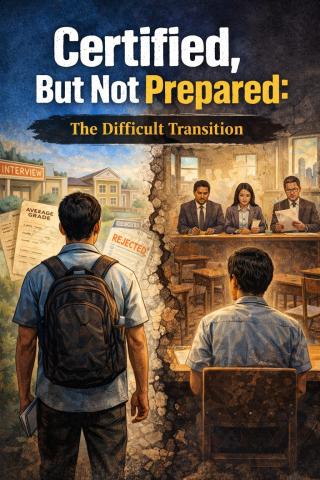
Certified, But Not Prepared: The Difficult Transition
As a student, average marks or performance may work. But how can someone hire you to teach when you fail to demonstrate the required skill and competence? This is why the transition is difficult—the transition from being a trainee to becoming a teacher. During pre-service teacher education, there are components like the School Experience Programme. Ideally, these are meant to be opportunities to learn the craft of teaching. But most teacher trainees take it as just another component to fulfil—another box to tick in order to get the degree. However, after the degree, when they walk into an interview board or enter a classroom to demonstrate their teaching skills, the gap becomes visible.
In my earlier posts, I have already been talking about the inadequacy of teacher education programmes—the outdated syllabus, staff shortages, demotivated individuals, and so on. All of this becomes a glaring reality when they try to enter the profession.
Most CVs read like this: 10th from a government school, 12th from a government school, B.A. from distance mode, D.El.Ed. or B.Ed. For many private schools, even calling such candidates for an interview becomes a challenge. Almost each entry in the CV begins to act as a red flag.
But is this only a question of competence? Or also structural exclusion? When private schools hesitate to hire, are they selecting for teaching ability—or are they also reproducing a certain class and language hierarchy? There is a visible discomfort in handing over children—often from English-speaking, urban, middle-class families—to teachers who themselves come from Hindi-medium government schooling backgrounds. Somewhere, the question of skill quietly merges with the question of social location.
Early-career teachers feel this deeply. They often share that they have submitted their CVs to dozens of schools but receive no calls. And even when they get shortlisted, they do not clear the interview. Yet, barring a few exceptions, this is how most teaching careers begin. Many young teachers submit to the exploitative demands of schools, and within a few years, they start hating the profession. The profession that was meant for inner gratification leads to early burnout.
It is now a well-documented fact that, given a choice, most teachers want to leave the job.
There could be several reasons, but one that needs immediate attention is the restructuring of the curriculum and training of pre-service teachers as per the demands of schools. Most young teachers bet on securing a government teaching job. But this is just a bet—it cannot be a real career choice. There is no clearly defined recruitment system, and a close observation reveals that the state is gradually withdrawing from creating stable teaching positions, relying instead on guest and contractual appointments.
So where does that leave the young teacher?
Between a degree that does not prepare, a system that does not absorb, and a profession that slowly exhausts. Most young teachers continue to wait—for a call, for an opportunity, for a government post. But how long can a profession survive on waiting? At what point do we stop asking why teachers are leaving—and start asking what kind of system we have built that they would want to stay?
- Log in to post comments