
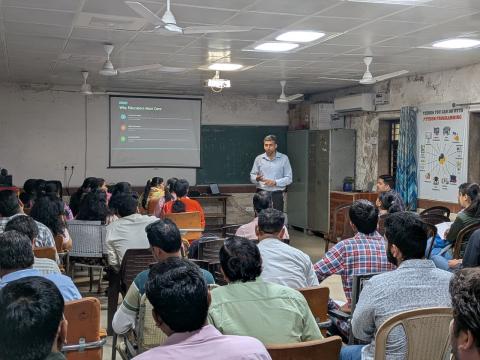
You Can Train Teachers, But Can You Transform Classrooms?
I was speaking to a curious researcher this morning. She asked a pertinent question: how do you ensure that what you teach teachers in teacher training programs converts into classroom practice? My honest answer was, I can’t ensure that.
Teachers are not software that can be programmed in a certain way and then start operating accordingly, no matter how deeply people in teacher training wish for it. A teacher’s classroom is deeply affected by their ontology—the question of who the teacher is in terms of identity, belief system, and value positions. This doesn’t get built over a week-long training program.
If we seriously want to see our classrooms change, the first interventions must be at the point of who becomes a teacher. Unfortunately, we have positioned this profession as non-aspirational. Literature often documents it as a profession one joins after failing to perform in other sectors. In the majority of cases, it is already the less motivated who enter the profession. And even if a few come in motivated, the profession gradually teaches them to be less aspirational.
I was speaking to a few of my students who are graduating from my college, and I asked them how much salary they expect when they begin their careers. They have already surveyed nearby schools, and they believe that ₹10–15k is good enough to start with. God knows what kind of educational innovations we expect from such economically deprived teachers.
There doesn’t appear to be any serious plan to make this profession aspirational. What makes a profession aspirational—higher remuneration, job satisfaction, mobility, and global opportunities—do we have concrete plans to bring these into teaching?
Despite this, while reaping the benefits of a demographic dividend, we still end up attracting some highly motivated individuals into the system. But then comes the next question: what do we offer to sustain their motivation? Almost nothing. Teachers are rarely appreciated in the system for their teaching and professional acumen. Yet, some are allowed to grow—not because of their pedagogical excellence, but because of their bureaucratic aptitude, their ability to perform repetitive tasks skillfully and with a high degree of subordination.
Hardly a system that nurtures the ontological journey of teachers.
Teachers who genuinely want to learn and grow, who wish to pursue higher education, are often discouraged—sometimes even actively resisted. On one hand, there is compelling evidence that teachers who learn are better teachers. On the other hand, we create structures that disincentivize that very learning. Instead, ritualistically, we offer standardized week-long training programs that often fail to make sense to teachers.
What can be done?
I think the answer does not lie in shortcuts. We have to address this problem on several fronts. First, we must ask how our best talent in classrooms can aspire to join the teaching profession—as is the case in some countries. Second, can we create ways to support the ontological journey of teachers already in service?
Some steps could include meaningful school-university alignments, where structured courses are offered and schools create enabling environments for teachers to pursue them. We can design exposure opportunities where teachers experience, first-hand, what high-quality teaching and learning look like. And above all, we need a collective mission to establish that teaching requires a commitment to lifelong learning.
- Log in to post comments