
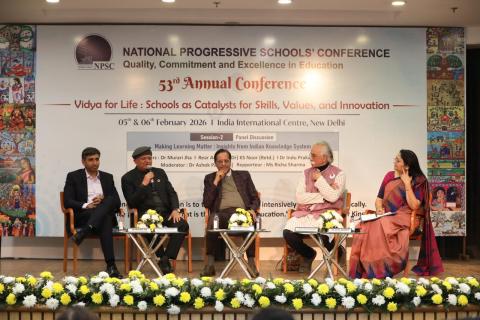
Rooted Knowledge for a Sustainable Future
I would like to begin with a simple assumption: Does knowledge have a system? Before I refer to the Indian Knowledge System (IKS), the answer is probably yes—knowledge does have a system. Let’s understand this with a very quick example.
As humans, we all have certain basic, fundamental instincts. We all feel hungry; that is natural and universal. But the moment it comes to what to eat and how to eat, social and cultural phenomena involve themselves. There is a system that defines what is considered 'food.' This is the knowledge system. We can implement this idea into any phenomenon we interact with.
For instance, I come from the Mithila region of Bihar. Chura-Dahi is a food that is a favorite for us, but for many others, this might not even be recognized as a meal. During my Fulbright program in the U.S., my roommate was from Côte d'Ivoire. We didn’t even recognize the kind of food the other was eating! I am giving you this example to show how a system shapes our understanding of something as basic as food, and that implies everything else as well.
Bringing this idea back to the classroom context—about ten years ago, I had students in my class from villages in Rajasthan. Delhi has the advantage of having students from all across the country. These students were using two words to describe water: kacha pani and pakka pani. This was new to me. However, for the other students in the classroom, it became a matter of ridicule; they said, 'Look, they don’t even know how to speak.' Actually, that child was referring to fresh water and salt water.
This is how the use of a particular term defines who we are and can lead to ridicule. I found a great connection with this idea in the book What is Worth Teaching? by Krishna Kumar. He refers to a conversation with a maid who told him she was 'uneducated' because she didn't know the names of the months like 'January' or 'February,' even though she knew them in Hindi. This is a striking understanding of how we categorize ourselves as 'educated' or 'uneducated.'
These are the places where we see the contestation of knowledge. The Indian Knowledge System is so contextualized that it gives us the opportunity to liberate ourselves. It validates that what you know is valuable—your words, your language, and your practices are valuable. IKS empowers that maid; it tells her, 'No, you are powerful. What you know is valuable because it helps you navigate your life.' It doesn't matter if you don't know 'January' or 'February.'
I am very glad that after almost 200 years, the NEP took a very strong stand and answered this context directly. I want to quote a specific part: 'Sanskrit, while also an important modern language mentioned in the Eighth Schedule of the Constitution of India, possesses a classical literature that is greater in volume than that of Latin and Greek put together.' Do you remember Macaulay’s claim about 'a single shelf of a good European library'? Almost 200 years later, the NEP answers this directly. That is the enabling environment in which we have placed IKS.
This is particularly important because the knowledge system influenced by the 'Global North' is failing on almost all counts. It is not able to answer most of the crises we are facing as humans right now. One of the greatest human pursuits has been to gain control over our lives. If you compare a person from 2,000 years ago to someone today—who has more control? Despite all the science and technology around us, we have no control over what food we eat, which air we breathe, or what water we drink. We don’t know what chemicals are in them. But a person 2,000 years ago, even with limited technology, had that control. If we view development in this context, the Global North's influence is failing us. The Indian Knowledge System can attempt to answer these concerns in a broad and holistic approach.
- Log in to post comments