
Standing Up to Speak: What Conferences Teach Us
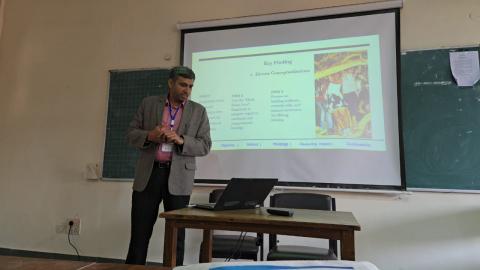
I am attending the Comparative Education Society of India (CESI) conference this week. In one of the sessions, I was seated in the front row when a speaker was invited to present. She walked up to the podium, adjusted the microphone, and spoke a single word before suddenly stopping. Her throat had dried up. She asked for water in a soft, almost apologetic voice. The anxiety and discomfort on her face were unmistakable. It was a point-blank moment: a room full of scholars, professors, researchers—all eyes on her. She stood there knowing that every word she would speak would be heard, questioned, examined, and that she would have to defend her ideas. For a few seconds, time seemed to stretch, and the silence of the room wrapped around her like a spotlight.
As I watched her, I felt an unexpected tug somewhere inside me. I was suddenly transported fourteen years back when I made my first academic presentation. I still remember my trembling legs, my dry throat, and the strange fear of being seen and heard at the same time. It is a unique kind of vulnerability that only academic spaces can create. And yet, I now believe that this vulnerability is precisely what makes such spaces essential. Academic conferences create an unfamiliar, slightly intimidating environment that pushes us beyond our comfort zones. In the familiar surroundings of one’s own college or university, students know the faces, the culture, the expectations. But a conference strips away that familiarity. Here, you speak in front of people who do not know your journey, your hesitations, your strengths, or your context. Space becomes a test and a possibility at the same time.
You speak.
You are questioned.
You respond.
And in that cycle, you grow.
This discomfort is not only common—it is necessary. John Dewey, in Democracy and Education (1916), wrote that growth often emerges from situations that unsettle us, that compel us to think anew. A conference does exactly that: it makes us slightly uncomfortable, and through that discomfort, it opens the door to deeper learning.
Another powerful dimension of a conference like CESI is the window it provides into the larger landscape of educational research. No matter how vibrant a university is, it cannot offer the complete picture. But stepping into a national conference means suddenly finding yourself in a dense forest of ideas—different research questions, different methods, different lenses, different urgencies. Just browsing the conference schedule becomes an education in itself. It shows you who is asking what, which themes are shaping the field, what concerns are emerging, and where the discipline seems to be heading. You meet scholars from different corners of the country—some working on themes you know well, some on ideas you never imagined were part of education research.
Slowly, over the years, these interactions begin to weave a professional community. You start recognising faces—not because they taught you, but because you have heard them present, read their work, argued with their ideas. These are the people who quietly, steadily, shape the academic environment you inhabit. And this network becomes a kind of breathing space.
Without it, scholarly life can feel isolating. Limited to classrooms, papers, and institutional responsibilities, one can lose motivation or direction. But a conference brings a gentle spark back into the routine—a new idea, a challenging question, a possible collaboration, or even a simple conversation over tea that stays with you long after the event ends.
And none of this happens without anxiety. I have seen even seasoned professors sit in the audience with their laptop open, pretending to take notes, when in reality they are rehearsing their own presentation scheduled next. Once, after my session, I asked a senior scholar how she found my talk. She smiled and said, “I’m sorry—I couldn’t focus; my mind was completely occupied preparing for my own session.” It was a reminder that no matter our experience, we all walk into these rooms with the same nervous heartbeat. In a strange way, that shared vulnerability becomes a source of solidarity.
CESI, in particular, holds a special place for me. It brings undergraduates, doctoral scholars, early-career academics, senior faculty, and even professors emerita under one roof. The diversity of experiences and journeys is remarkable. In a country like India—with nearly 300 million children in school, 10 million teachers, and an ever-expanding higher education sector—spaces like this matter deeply. They shape narratives, challenge assumptions, and help us imagine more equitable futures for education. Another encouraging aspect is how CESI has transformed in recent years. It is no longer just a once-a-year gathering. The RIGs now organise webinars, workshops, discussions, and pre-conference events throughout the year, making it a living, breathing intellectual community rather than an annual ritual. Academic spaces like CESI do more than showcase research—they cultivate courage, nurture inquiry, and remind us that learning is, at its core, an act of showing up even when our voice trembles. And perhaps this is why we return to these conferences year after year: not because we have mastered our anxieties, but because we have learned to walk with them, and to grow through them
- Log in to post comments