
Reading Education in the Budget
The union budget was presented today. I often say, “If we want to assess the seriousness of a policy, look at its budgetary allocation — the rest is just the conversation around it.” Speeches inspire, announcements excite, and headlines travel fast. But numbers tell the real story. This time, there isn’t much that directly transforms the education landscape in a big, structural way. Yet, if we read between the lines, the budget does try to address two crucial areas that deeply influence the future of education in India.
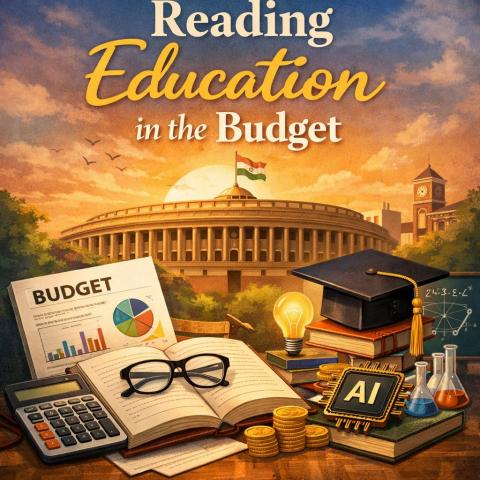
The first is Artificial Intelligence (AI) — a force that is already bringing a paradigm shift in how we understand, learn, work, and interact with the world. The government appears convinced that AI is no longer optional; it is foundational. The budget proposes “specific measures for embedding AI in the education curriculum from school level onwards and upgrading State Councils of Educational Research and Training institutes for teacher training.”
This is significant. If AI is shaping the future of work, knowledge, and society, then integrating it early into school education is not merely about technology — it is about preparing children for a new way of thinking. However, introducing AI into classrooms cannot just mean adding a chapter in textbooks. It requires trained teachers, updated pedagogy, digital infrastructure, and thoughtful ethical conversations. The budget proposes to upgrade SCERTs for teacher training. Therefore, this is an important step, because reform in classrooms always begins with reform in teacher preparation.
The second noteworthy move is the proposal to create University Townships. The government plans to support states in establishing five such townships near major industrial and logistics corridors. These zones are envisioned as hubs that will host multiple universities, colleges, research institutions, and skill centres. The idea is promising. When higher education institutions grow alongside industry and research ecosystems, learning becomes more relevant, innovation more applied, and opportunities more accessible. Such clusters can potentially reduce the gap between education and employment — a gap that has long worried both students and policymakers.
Another welcome announcement is targeted support for girls in STEM (Science, Technology, Engineering, and Mathematics). Recognising that prolonged study hours and residential challenges often discourage girls from pursuing STEM fields, the budget proposes viability gap funding and capital support to establish one girls’ hostel in every district. This may sound like a small infrastructural step, but its impact can be transformative. Access is not just about admission; it is also about safety, accommodation, and dignity. Sometimes, a hostel room can decide whether a dream continues or ends.
These initiatives deserve appreciation. Yet, we must also hold space for a larger question: Is this enough?
Education in India falls under the Concurrent List, meaning both the Centre and the States share responsibility. In practice, however, major regulatory frameworks are often designed at the central level. States, which actually run most schools and colleges, frequently struggle with limited financial resources. If the Union government envisions ambitious reforms, it must match them with significantly higher financial commitments.
What has been proposed is necessary, but it is far less than what India requires if it truly wants to emerge as a global education hub.
A recent NITI Aayog observation notes that India attracts only one international student for every twenty-five Indian students who go abroad for higher education. This imbalance is an alarming indicator of our global educational standing. It tells us that while our young people trust foreign systems for quality and opportunity, the world is not yet looking at India with the same confidence.
If we look carefully at which countries shape the global narrative, the answer is not simply those with the biggest economies. It is those with strong educational and research ecosystems. Knowledge builds influence. Universities produce ideas. Research shapes policy. Innovation drives power. In that sense, “knowledge controls the narrative, and everything else functions under that narrative.”
If India truly aspires to become a Vishwaguru, the path will not be paved only with declarations of heritage or demographic strength. It will be built through sustained, large-scale investment in knowledge production — in schools, universities, research labs, teacher education, and public scholarship. Budgets are moral documents. They reveal what a nation chooses to prioritise today in order to shape its tomorrow. The steps announced this year move in the right direction, but the journey toward educational leadership demands far greater commitment. Because in the end, it is not the loudest voice, but the most knowledgeable one, that leads the world.
- Log in to post comments